It was three short years ago that the June 30, 2014 cover of Sports Illustrated proclaimed the Houston Astros as “your 2017 World Series champs.” Widely mocked at the time — to put it politely — that cover is looking quite clairvoyant now.
The team presently sits at 42-18 and is comfortably pacing the entire league. Their dominance is thanks to the best offense and pitching staff in the American League.
So how did the Astros — not long ago one of baseball’s preeminent laughingstocks — build such a powerhouse? Let’s take a look.
The Amateur Draft
Almost all of the Astros’ core players were drafted and developed by the club. When general manager Jeff Luhnow took the reins after the 2011 season, he saw an organization devoid of talent, and immediately began long-term planning to build a contender. It meant that the 2011-2013 Astros all lost 100 games and were nearly unwatchable, but it also meant that the team was getting a pile of high draft picks.
The MLB Draft, moreso than any other sport’s, is an extremely inexact science. After all, a fair number of first-round picks never even make it to the majors, be it thanks to injury, a lack of development, or a combination thereof. The point is that having a high draft pick offers no guarantee of getting a good player. Luhnow, though, made his name in scouting and particularly player development, making him a perfect fit for this project. The Astros hit home runs with an astonishingly high number of their draft picks.
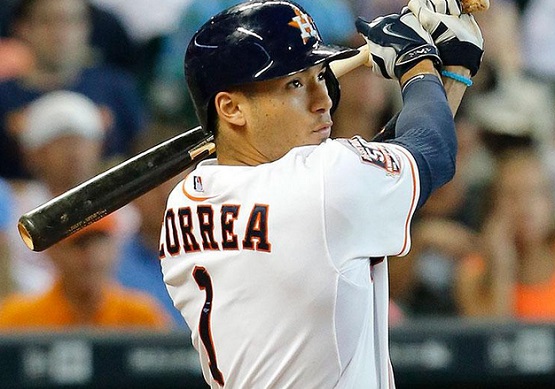
The list of successful draft picks is impressive, and it predates Luhnow’s arrival. Ace pitcher Dallas Keuchel was a seventh-round pick in 2009. Outfielder George Springer went No. 11 overall in 2011 — the final draft the Astros had before Luhnow’s arrival. A year later, they made shortstop Carlos Correa the No. 1 pick in the draft, and augmented it with starter Lance McCullers at No. 41 overall. Alex Bregman was the last highly-touted first round pick to enter the fold, going No. 2 overall in 2015.
Even the Astros couldn’t get it all right. The decision to make Mark Appel the No. 1 overall pick in 2013 — ahead of Kris Bryant — looks bad in retrospect. They also failed to sign 2014 No. 1 overall pick Brady Aiken, but they were able to get the compensatory pick out of the ordeal that they used to select Bregman, so it wasn’t a total loss.
While he wasn’t a draft pick, second baseman Jose Altuve was signed as a 16-year-old after a tryout at the Astros’ academy in Venezuela, thus making him fully developed by the club as well. His transformation from undersized curiosity to arguably the best second baseman in the sport has been a huge part of Houston’s rise.
Suitable Free Agent Signings
The Astros have not been particularly reliant on free agents as part of their construction, preferring instead to spend modest amounts of money on the right fits for the team as opposed to throwing money at the best available options. They’ve also put more focus into shorter-term deals as opposed to lengthy pacts.
Carlos Beltran is the finest example of this. He’s committed for $16 million, but only for a year. Outfielder Josh Reddick signed four years, but at $13 million a year, the financial commitment is very much bearable. Luke Gregerson, who has been one of the team’s key relievers since joining in 2015, is in the final year of an $18 million deal, and starter Charlie Morton, who has helped shore up the rotation, is on a modest two year, $14 million deal.
Houston’s free agent spending has not been excessive, and has generally focused on augmenting their gifted core rather than adding to it.
Shrewd Trades
Luhnow has made numerous trades that either flew under the radar or were met with raised eyebrows at the time they happened, but have worked out swimmingly for the club.
Chris Devenski has turned into something of a super-reliever for the club, a guy striking out nearly 14 batters per nine this season, and he was the player to be named later in a 2012 deal that saw Houston send Brett Myers to the Chicago White Sox. Key role player Marwin Gonzalez was picked up in a little-heralded 2011 deal. Evan Gattis and Brian McCann were both deemed expendable by the Atlanta Braves and New York Yankees, respectively, and acquired for a modest price. Starter Mike Fiers was the secondary piece in the otherwise ill-fated Carlos Gomez trade in 2015.
That’s not to say the Astros are averse to a big splash when they need one.
The Ken Giles trade came at a significant price in prospects, but part of the benefits of Houston’s farm depth has been their willingness to dangle those prospects to get players who can help the team win now. Luhnow has even gone as far as to say that it could have happened even more frequently if not for some players with no-trade clauses who blocked potential moves to the Astros during the leaner years.
A Clear Philosophy
It is no coincidence that the Astros have been very good at evaluating talent — even talent that is undervalued by other organizations — at both the major and minor league levels.
From day one of Luhnow’s tenure, he knew how he wanted the organization to move forward. An emphasis on youth, drafting, and player development was key. It isn’t all that dissimilar to the strategies the Chicago Cubs used to end their World Series drought, and with that in mind, it’s perhaps no surprise that the 2017 Astros bear a striking resemblance to the 2016 Cubs.
There are differences, of course.
Luhnow has emphasized an even bigger data-driven approach to constructing his team, and it has showed. He’s willing to trade some strikeouts for a high OBP and stolen bases. The team was a huge proponent of defensive shifts, making them a regular feature long before the rest of the league joined in. Luhnow was, after all, originally hired by the St. Louis Cardinals with no baseball experience to speak of. He provides an outsider’s perspective and is willing to challenge the established wisdom and tradition if it doesn’t make sense to him and isn’t backed by the data.
It’s that emphasis on data that has allowed Luhnow and the Astros to get ahead. Their exemplary drafting has come, in part, due to data analysis. Their astute trades and free agent signings came about after they looked at measurables that other teams didn’t see or value as highly. Like Billy Beane and Theo Epstein before him, Luhnow sought to exploit market inefficiencies and find the next big revolution, and there is some evidence that he’s succeeded in that mission.
Even when the Astros were bottom-feeders, Luhnow and the entire Houston organization stuck to the principles and the plan. They knew that the payoff would be worth it, and the 2017 Astros are proving them correct. Their present test — turning all these concepts and ideas and players into a championship team — may be their toughest task yet. But this is a team that just two years ago came within six outs from upending the eventual champion Kansas City Royals in the ALDS. Don’t be surprised if they’re wearing the crown when October concludes.