Just as the prophecy of the ancient scrolls foretold many moons ago, the Golden State Warriors and the Cleveland Cavaliers are once again on their way to an NBA Finals collision course. Will this Episode 3 be the Revenge of the Sith or the Return of the King? Here are the five crucial matchups that will likely be the biggest determinants for this year’s Finals.
1. LeBron James vs. Kevin Durant
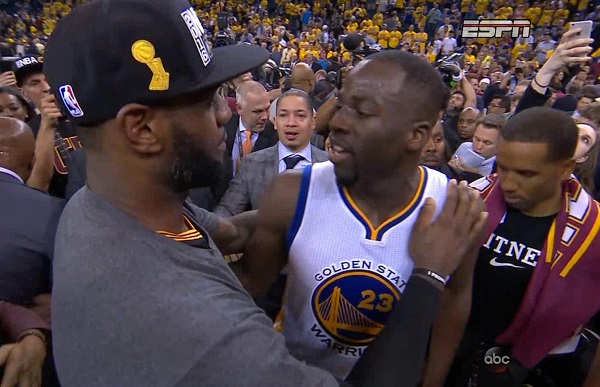
If you’ll recall last year, one of the primary turning points of the Finals series came when Tyronn Lue, his Cavs facing an 0-2 deficit, shifted James onto Draymond Green for Game 3. A shrewd tactic that essentially neutralized the Stephen Curry-Green pick-and-roll that had incinerated opposing defenses whole to that point of the postseason, Cleveland won Game 3 by 30 points and went on to win three of the final four games of the series as well (also benefiting from a timely Green suspension in Game 5).
That luxury will not be available this time around.
Glaring across the floor at James from the small forward spot is a Slim Reaper-sized beast who still hungers to hoist the Larry O’Brien Trophy for the first time. Durant hasn’t forgotten the James-induced suffering of the 2012 Finals, back when they still sported the colors of the Oklahoma City Thunder and the Miami Heat.
Yes, Durant will ensure that James has zero margin for error or lethargy on defense and will use every inch of his Frankenstein wingspan to disrupt The King’s airspace and passing lanes alike. At the same time, James should be game to pester the Durantula for all 94 feet up the floor and punish his wiry frame on the block and in transition. Two all-time greats going at it while still very much at the peak of their powers, microcosmic of the once-in-a-lifetime appeal that this rubber match between the Cavs and the Warriors, basketball giants in every sense of the term, holds. Prepare your bodies, hoops fans.
2. Stephen Curry vs. Kyrie Irving
The Chef vs. the Uncle. Who can ever forget last year’s iconic image of His Majesty, Kyrie Eleison raining down his angelic aerial strike from the right wing over the outstretched arms of Curry to clinch the epic Game 7 slugfest? There’s just something about going up head-to-head against the reigning back-to-back MVP that always seems to bring out the best in Irving.
Perhaps he can smell the blood — Curry’s production (27.3 points and 7.1 assists a game) and efficiency (47/41/90 shooting splits) in the 2017 playoffs are actually at or near his lowest totals since the end of the Mark Jackson era (though that slightly decreased output may have something to do with the addition of a certain decent teammate to the Golden State lineup this season).
With Irving’s 42-point eruption in Game 4 of the Eastern Conference Finals possibly the beginning of a postseason reawakening, Cleveland fans will hope the stars align in their favor at the point guard position once again this year.
3. Tyronn Lue vs. Mike Brown
We know that Brown, whose steady hand at the helm of the S.S. Warriors has helped them weather the storm of Captain Kerr’s absence, will be taking this matchup against his former team quite personally. He has also apparently been trying to go Joe Budden on his cross-sideline counterpart in Lue.
Vendetta narratives aside though, Brown has actually flashed a surprisingly intuitive feel for the flow of the game this postseason. Whether it be starting JaVale McGee situationally, trusting the likes of Patrick McCaw and Ian Clark for heavier burn, or giving his All-Stars a longer leash to help buoy the second unit, his moves have paid off.
Getting the better of Lue, who himself has become an underrated in-game tactician with some strong strategic calls these playoffs (e.g. trotting out lineups with LeBron James at the 5, bleeding Channing Frye’s minutes in favor of podcasting partner Richard Jefferson, etc.) will be absolutely imperative, even despite the superstar-driven nature of this series.
4. Defense vs. rebounding
On paper, the largest gap between these two teams is easily on the defensive end. The Warriors defend at an elite level. The Cavs sometimes goes through entire possessions looking like Rip Van Winkle. How can they best address that disparity? [cups hands over mouth] “ON THE BOA-ARDS!” [clap, clap, clap, clap, clap] “ON THE BOA-ARDS!” [clap, clap, clap, clap, clap]
The basic blueprint for slowing down the Dubs dynamo is largely predicated on denying them any and all second-chance opportunities. Turnovers notwithstanding, a defensive trip down the floor is never complete until the rebound is ultimately collected. That’s where Kevin Love and Tristan Thompson, who averaged a combined 20.3 of them per game during the regular season, come in. Love began to return to Minnesota levels of glass-munching in the Boston series, and Thompson has long been a thorn in Golden State’s side with his interior activity and box-out fundamentals.
How can the Warriors respond? Draymond Green and Kevin Durant are strong rebounders for their position but are nonetheless undersized, and neither the big bones of Zaza Pachulia nor the pogo-stick-with-a-rattail athleticism of JaVale McGee effectively translate into sustainable performance on the boards. Limiting the opposition to one-and-done possessions while securing precious extra 24-second intervals via their own offensive glass may be Cleveland’s best chance to overcome their cheapjack defensive play.
5. Paint vs. perimeter
Contrary to what might be popular belief, the Cavs hit more three-pointers than the Warriors do and the Warriors score more points in the paint than the Cavs do. Both sides are masterful at leveraging a strength on one portion of the floor to open up a useful chunk of real estate on another portion of the floor, albeit on very opposite ends of the offensive spectrum.
But even that has its limits — overreliance on the three-ball arguably helped contribute to Golden State’s downfall in last year’s Finals, particularly down the stretch of Games 5, 6, and 7. Meanwhile, LeBron James and Kyrie Irving can’t possibly hope to just respectively Tonka truck and tap dance their way through the Warriors’ ferocious team D on every other possession, as they often did through the first three rounds.
Find the better-balanced overall offensive attack, and there will likely lie your winner.